Counting piano tuners, counting tokens
Peter Steinberger ran 603 billion tokens through Claude Code last month. $1.3M in API fees, one person. The frontier labs want that to be the new normal. A Fermi estimate of what that future costs in watts.
The famous Fermi problem goes: how many piano tuners are there in Chicago? Enrico Fermi liked to make his students answer it in their heads. Three million people, maybe one piano per twenty households, pianos get tuned roughly once a year, a tuner can do a few houses a day for two hundred days a year. Out the other end falls a number that’s correct to about a factor of two. The point wasn’t piano tuners. The point was that you can pin a real quantity to within an order of magnitude from first principles, without measuring anything, as long as you pick the right multiplicands.
Peter Steinberger posted his Claude Code billing for the last 30 days: 603 billion tokens, about $1.3 million in API fees. One person. One month.
The number is striking on its own. What I keep getting stuck on is the pitch behind it. Every frontier lab is telling investors and customers the same story right now: Peter is just early. The plan is for every knowledge worker to have a swarm of agents running in the background, all day, every day. At Peter’s per-user intensity.
Joules per token
Every output token a frontier MoE produces costs some energy at the chip. Multiply by datacenter overhead (PUE) and you get energy at the wall. Multiply that by a daily token rate and you get continuous power. Multiply that by population and you get a number you can compare to nameplate grid capacity.
The whole chain hangs off the first number. Joules per token at the wall. So we start there.
Eq token_energy: at the wall
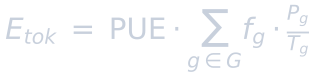
| Symbol | Meaning | Default |
|---|---|---|
G | GPU types in the fleet | {H100, B200} |
f_g | Fleet fraction of GPU g, sums to 1 | 0.5 / 0.5 |
P_g | GPU TDP, watts | 700 / 1000 |
T_g | Batched output throughput, tokens/sec/GPU | 200 / 600 |
PUE | Datacenter power usage effectiveness | 1.4 |
For a 50/50 H100/B200 mix at PUE 1.4, that lands around 3 J per output token.
A note on T_g. Frontier-MoE serving throughput depends on batch size, model architecture, KV-cache discipline, and whether you’re using speculative decoding. The 200 and 600 here are middle-of-the-road estimates for production serving of a Claude-Sonnet/GPT-5.5-class model on each GPU. Swap your own numbers in.
Eq cache_adjust: what agent traffic actually looks like
The 3 J number is for a naive token, billed at full output-equivalent compute. Real agent traffic is nothing like that. A typical session is mostly the same prompt prefix re-read on every turn, hitting prefix cache. Cache hits skip ~99% of the attention compute. So the effective cost per nominal token is much lower than the chip-level number suggests.

| Symbol | Meaning | Realistic default |
|---|---|---|
α_o | Share of nominal tokens that are output | 0.05 |
α_m | Share that are cache-miss input | 0.20 |
α_h | Share that are cache-hit input | 0.75 |
β_m | Cache-miss input cost vs output token | 0.10 |
β_h | Cache-hit input cost vs output token | 0.01 |
The defaults represent an average user running an agent through a working day: frequent tool use, some RAG, gaps between sessions. Peter himself sits at the optimistic edge of this range (closer to 0.02 / 0.08 / 0.90, since his sessions are long and continuous on a stable codebase); workloads that don’t cache cleanly sit further out. Plugging the realistic defaults in:
E_eff ≈ E_tok · (0.05 + 0.20·0.10 + 0.75·0.01)
      ≈ E_tok · 0.0775
      ≈ 0.23 J / nominal token
Agent-shaped traffic at this profile is roughly 13× cheaper than the naive number. Strip the cache entirely and the same workload costs 13× more. Closer to 700 kW per person at the per-user rate we compute next.
Eq user_load: from tokens to watts

R is tokens per day per user, 86400 is seconds in a day. At Peter’s volume (603B/month → ~20B/day) and the realistic E_eff = 0.23 J/tok:
P_user = 20e9 · 0.23 / 86400 ≈ 53,000 W ≈ 53 kW continuousOne Peter-rate user (someone burning Peter’s daily token volume at average cache behavior) draws roughly the same continuous power as forty average US households. Peter himself, on his more cache-friendly profile, comes in around 26 kW. Half that, but still twenty households’ worth of grid for one person.
Eq pop_load: scaling up

This is where the numbers start to misbehave.
Eq grid_ratio: against the grid
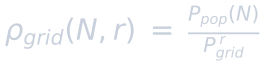
For region r, what fraction of its average electricity load does Peter-rate adoption consume?
Eq kardashev_frac: against the sun
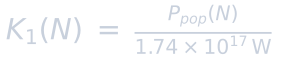
The denominator is the solar power hitting the top of Earth’s atmosphere. That’s the Type-I civilization threshold on the Kardashev scale.
When the cache doesn’t bail you out
β_h = 0.01 is doing most of the work in this post. A factor-of-100 discount on the cache-hit portion of every nominal token is what keeps per-token energy for an agent affordable. The 75% hit-share in the body’s defaults is doing the rest.
Prefix caching keeps the attention KV cache for a prompt prefix in GPU memory after the first request. The next request with the same prefix skips prefill for the cached portion. No forward pass through those tokens, just a memory load. That is where the 100× comes from. The cache lives in HBM as a per-conversation resource with a TTL around five minutes on Anthropic and similar windows on the others. When it expires, the next request pays full prefill plus a cache-write at roughly 1.25× input price to rebuild it.
Cases where the 75% hit-share doesn’t hold:
- Cold starts. First request of any conversation pays full prefill. A user with many short conversations a day runs
α_hcloser to 0.4 than 0.75. - Bursty turns. Ten minutes between agent messages and the cache has aged out. Each refresh is a cache-write, and a few per session erase most of the discount.
- Tool-mutating agents. Every tool result is appended to the conversation. The cache is only valid up to that point, so long agent runs with 20+ tool calls invalidate and rebuild the prefix over and over. Effective
α_hlands somewhere between 0.9 and 0.5. - RAG-heavy workloads. Retrieved chunks are cache-miss by definition. Only the system prompt caches, so
α_hdrops to whatever fraction the stable prefix is, often 30 to 50%. - No cross-user sharing. Two users with identical system prompts don’t share a cache. Every Cursor user with the same 8,000-token preamble pays for their own copy in HBM.
Peter himself sits at the cache-friendly end. Plug his profile of 0.02 / 0.08 / 0.90 and E_eff drops from 0.23 J/tok to 0.11 J/tok. Per-user power halves, every population number halves. Now plug a pessimistic profile of 0.05 / 0.45 / 0.50 and E_eff jumps to 0.55 J/tok. Every number doubles in the other direction. The realistic middle sits where the body’s defaults are; the range either way is about 2×.
Cache hits cost 1% of an output token because the work was already done; the model is reading, not computing. The factor of 100 is what falls out when you replace compute with memory access. The same trade shows up in a few different shapes: KV cache, semantic recall over past sessions, cross-user prefix sharing.
Running the chain
The equations chain in one direction. The algorithms run that chain forward or backward, depending on what question you’re asking.
Alg 0: forward pass
Inputs: fleet composition, PUE, cache parameters, per-user rate R, population vector N[]
Outputs: P_pop[], ρ_grid[], K_1[]
1.  E_tok ← PUE · Σ_g f_g · P_g / T_g
2.  E_eff ← E_tok · (α_o + α_m·β_m + α_h·β_h)
3.  P_user ← R · E_eff / 86400
4.  for i in 1..|N|:
5.      P_pop[i]   ← N[i] · P_user
6.      ρ_grid[i]  ← P_pop[i] / P_grid_region[i]
7.      K_1[i]     ← P_pop[i] / 1.74e17
8.  return (P_pop, ρ_grid, K_1)
O(|G| + |N|). The whole point of the equation chain is that this loop is trivial.
Alg 1: how many fit
Inverse: given a power budget and a Peter-rate R, how many users fit?
inputs:  G, PUE, cache params, R, P_budget
output:  N_max

1.  E_eff   ← (steps 1–2 above)
2.  P_user  ← R · E_eff / 86400
3.  N_max   ← floor(P_budget / P_user)
For R = 20B tok/day, E_eff = 0.23 J/tok, and P_budget = current US electricity average (480 GW), N_max ≈ 9 million. Roughly the population of New York City. That’s the rough headroom in today’s grid for one Peter-rate worker per slot, if we spent the entire US grid on agent inference and nothing else. Which we won’t.
Alg 2: the gap
The roadmap question. What E_eff do we need to make N_target users at rate R fit inside budget P_budget?

inputs:  N_target, R, P_budget, E_eff_current
output:  E_eff_target, gap

1.  P_user_max   ← P_budget / N_target
2.  E_eff_target ← P_user_max · 86400 / R
3.  gap          ← E_eff_current / E_eff_target
Set N_target = world population, P_budget = world electricity (3.3 TW), R = 20B tok/day:
P_user_max   = 3.3e12 / 8.1e9 ≈ 407 W
E_eff_target = 407 · 86400 / 20e9 ≈ 1.76 mJ/tok
gap          = 0.23 / 0.00176 ≈ 130×
We’d need a 130× reduction in J-per-effective-token for the whole world to run agents at Peter-rate inside today’s electricity supply. Not 130× the GPU throughput. 130× the energy per token at the wall.
At scale
With E_eff = 0.23 J/tok and P_user = 53 kW:
| Cohort | N | P_pop | Reference |
|---|---|---|---|
| Small town | 25,000 | 1.3 GW | one Hoover Dam |
| Major US city | 75,000 | 4.0 GW | four large nuclear units |
| Major US metro | 5,000,000 | 265 GW | 55% of total US electricity |
| NYC | 8,300,000 | 440 GW | 92% of US electricity |
| USA | 335,000,000 | 17.8 TW | 94% of total world primary energy |
| China | 1,410,000,000 | 75 TW | 4× world primary energy |
| World | 8,100,000,000 | 429 TW | 23× world primary energy |
For the world-scale row, K_1 ≈ 2.5 × 10⁻³. Current humanity sits at K_1 ≈ 1 × 10⁻⁴, so this is roughly 25× our current energy footprint.
So watt?
One Peter-rate user runs about 53 kW continuously. Forty US households of grid, plugged into one IDE.
Scale that up the obvious way. A town of them draws a Hoover Dam. An NYC of them draws 92% of total US electricity, used for nothing else. A whole world of them draws twenty-three times the energy humanity currently uses for everything we do: heating, transport, industry, light.
Almost all of it rides on β_h, the cache-hit cost. Today’s value sits at about a hundredth of an output token. Drop it tenfold and the whole stack shifts down with it. Lose the cache discount entirely and one Peter-rate user stops fitting in a rack.
“Peter is just early” weighs twenty-three civilizations.